A fragile partnership under pressure
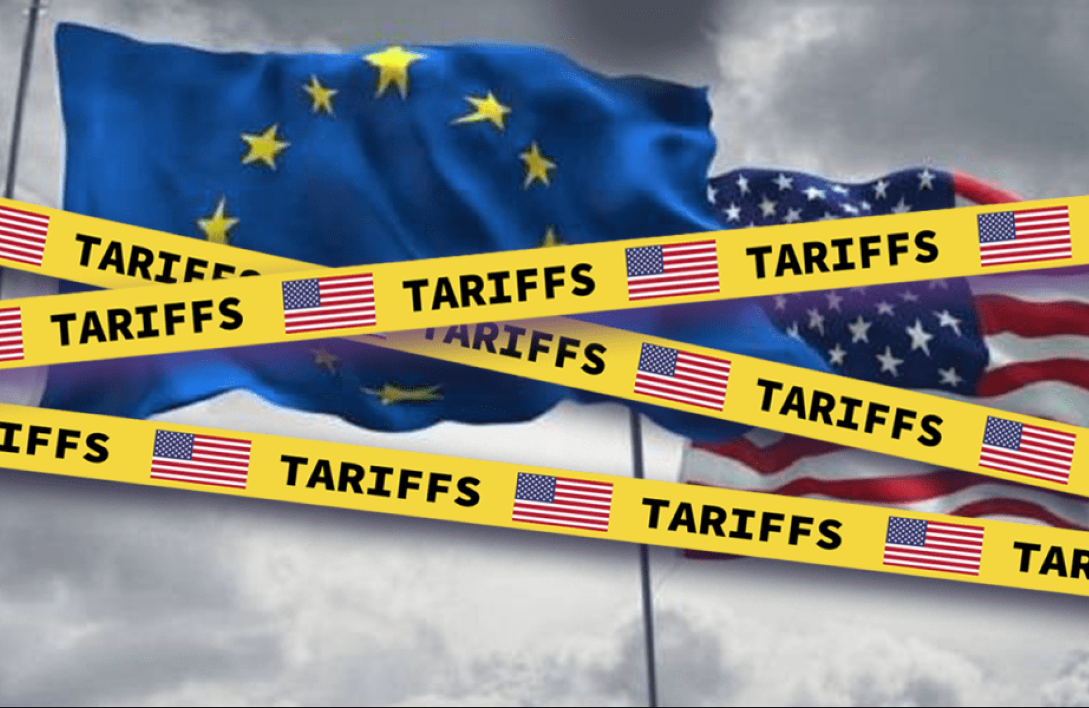
The United States and the European Union — long-time allies and trade partners — are once again entering turbulent waters.
What was once a partnership defined by open markets and cooperation is now marked by mutual suspicion and economic protectionism.
At the heart of the dispute: tariffs, subsidies, and competing visions of industrial policy.
While the trade war between the U.S. and China dominates headlines, a quieter but equally consequential conflict is emerging across the Atlantic — a tariff tension that threatens to reshape the global economy.
From allies to economic rivals
For decades, the transatlantic relationship was the backbone of global trade.
The U.S. and Europe built an open economic system grounded in free markets, shared standards, and mutual trust.
However, that system began to fracture in recent years, starting with the Trump administration’s decision in 2018 to impose tariffs on European steel and aluminum, citing “national security” concerns.
Although those tariffs were later eased, the underlying friction never disappeared.
The Biden administration, while more diplomatic, has continued using industrial policy tools and targeted tariffs to protect American industries — particularly in green technology, semiconductors, and electric vehicles.
For Europe, this feels like a betrayal from an ally.
Instead of partnership, Washington’s new approach looks increasingly like economic competition.
The Inflation Reduction Act: A turning point
The Inflation Reduction Act (IRA), passed in 2022, is a game-changer.
It offers $369 billion in subsidies and tax credits for clean energy, battery production, and EV manufacturing — but only for products made in the United States.
That clause effectively penalizes European companies that produce abroad and excludes them from U.S. markets unless they relocate operations.
The EU argues this violates World Trade Organization (WTO) principles and undermines fair competition.
Several European giants — including Volkswagen, BMW, and Northvolt — have already announced plans to expand production in the U.S. to access these benefits.
Brussels fears an industrial drain that could cost Europe thousands of jobs and billions in investment.
Europe’s countermeasures
In response, the European Union has tried to strike a balance between retaliation and pragmatism.
The EU Green Deal Industrial Plan aims to strengthen domestic clean-tech manufacturing and reduce dependence on U.S. and Chinese subsidies.
It includes easing state aid rules, encouraging local investment, and creating the European Sovereignty Fund to finance industrial projects.
Yet, Europe’s challenge is structural:
Unlike the U.S., the EU cannot move quickly on economic policy due to complex decision-making among 27 member states.
This makes it difficult to deliver subsidies at the same scale or speed as Washington.
As a result, Europe’s defensive measures often arrive too late or too fragmented to counteract U.S. incentives effectively.
Tariffs and technology: the next flashpoint
Tariffs are not only about steel or cars anymore — they are becoming tools in a larger geopolitical struggle over technology and supply chains.
Both the U.S. and the EU want to reduce their dependence on China, but they disagree on how to do it.
When Washington imposed sweeping export controls on advanced chips to China, it expected its allies to follow suit.
Europe, however, has hesitated — especially countries like the Netherlands, home to ASML, a global leader in semiconductor equipment.
The EU wants to protect its own industry while maintaining autonomy in trade policy.
This divergence has created tensions over tech alignment, with Washington accusing Europe of being “too soft” on China, while European leaders accuse the U.S. of acting unilaterally without consultation.
The risk of a transatlantic tariff war
If these disputes continue, both sides may resort to new tariffs — this time targeting automobiles, green technologies, and luxury goods.
U.S. officials have already hinted at tariffs on European EVs, arguing they benefit unfairly from EU subsidies.
Meanwhile, European lawmakers are discussing possible retaliatory measures if American policies continue to disadvantage European firms.
A full-blown trade war remains unlikely, but selective tariffs and regulatory barriers could escalate quickly, especially as both sides enter election cycles.
The political temptation to “protect domestic jobs” often outweighs the long-term logic of free trade.
Economic consequences: higher costs, slower growth
For consumers and businesses, the consequences are clear.
Tariffs raise production costs, disrupt supply chains, and create uncertainty in investment planning.
According to the OECD, even small tariff increases between major economies can reduce global GDP growth by up to 0.5% annually if sustained.
European exporters, particularly in the automotive and machinery sectors, are already feeling the pressure.
The U.S. market accounts for roughly 18% of EU exports, and any new trade barriers could lead to job losses across Germany, France, and Italy.
At the same time, American consumers would face higher prices for European goods, further fueling inflation — the very problem the Inflation Reduction Act was designed to fight.
The way forward: cooperation or confrontation
Both sides acknowledge that open conflict would be mutually destructive.
Diplomatic efforts are underway through the EU-U.S. Trade and Technology Council (TTC), which aims to align policies on green industries, AI, and supply chain security.
However, progress has been slow, and political patience is wearing thin.
To avoid a tariff war, the U.S. and Europe need a new framework for industrial coordination — one that balances competition with collaboration.
Joint funding for research, shared standards for clean technology, and coordinated investment in supply chains could turn rivalry into synergy.
But that requires political will — something that seems increasingly scarce on both sides of the Atlantic.
Conclusion: Allies divided by economics
The U.S. and Europe remain bound by history, values, and defense alliances.
Yet economically, they are drifting apart.
Tariffs and subsidies, once aimed at China, now threaten to fracture the Western alliance itself.
Unless leaders act decisively, the transatlantic relationship could transform from cooperation into quiet economic warfare — one fought not with armies, but with tariffs, trade rules, and subsidies.
The future of global trade may depend on whether Washington and Brussels can remember what once made them strong allies: trust, dialogue, and a shared belief that open markets — not protectionism — drive prosperity.